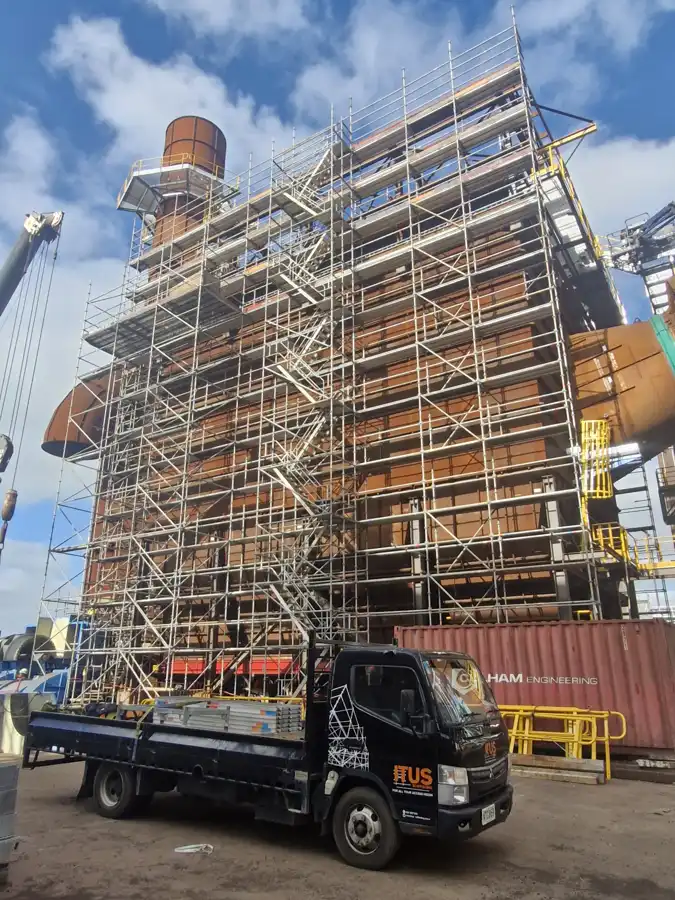
Part of our scaffolding guide.
Begin with the work pattern
Write down whether people need access along a whole elevation, at several working levels or at a series of separate positions. Note the tools and materials involved, how many people need access and how long each stage is likely to take.
Our commercial scaffolding service supports construction and maintenance access. A scissor lift is a mobile elevating work platform; its suitability needs to be assessed with the equipment provider and the people responsible for the work.
Compare the requirements, not just the reach
| Factor | Scaffolding | Scissor lift |
|---|---|---|
| Work area | A planned platform arrangement can serve defined elevations and levels. | A platform serves work positions within the selected machine’s operating limits. |
| Movement | Layout and any alterations need planning; mobile towers have their own movement requirements. | Plan travel, repositioning and a suitable route for the machine. |
| Ground and access | Assess support, access points and the space around the layout. | Assess ground or floor suitability, entrances and the machine’s operating space. |
| Project sequence | Include installation, use by different trades and dismantling. | Include delivery, authorised operation, repositioning and collection. |
Two example decisions to work through
Several trades along a building elevation
A facade repair followed by painting may need repeat access along the same area. Discuss the working levels and trade sequence as part of the scaffold option. Compare that with the operating positions, time and site controls a lift would need.
Separate maintenance points inside a workplace
A series of overhead tasks may require frequent movement. Compare the route, surface, doorway constraints and work positions before choosing equipment. Include the controls needed around people and business activity, not only the time spent at height.
Include use and emergency arrangements
Equipment selection needs to account for the people using it and the risks of the task. Confirm training, authorisation, checks and emergency arrangements with the responsible parties. Confirm that the machine suits the space and work as well as the required reach.
For a smaller movable work platform, read our mobile scaffold quote checklist. It helps you explain the task and ask about assembly, movement and hire responsibilities.
Bring these details to the comparison
- Work area and task height, including any horizontal reach.
- Number of people, tools and materials at each position.
- Sequence and likely duration of the work.
- Surface conditions, access route and available space.
- Public or workplace activity around the task.
- Responsibilities for equipment, operation and changes.
Our working-height guide helps clarify measurements. Use the scaffold quote worksheet when reviewing the scaffold option’s scope.
Your questions
Is a scissor lift always cheaper than scaffolding?
Compare the complete arrangements for your job, including duration, access, operation and logistics. A headline rate does not describe the same scope for both methods.
Can I use the same height figure to compare both?
First establish what each figure describes. Work position, platform height and equipment dimensions are different measurements, and the selected equipment must suit the task and site.